
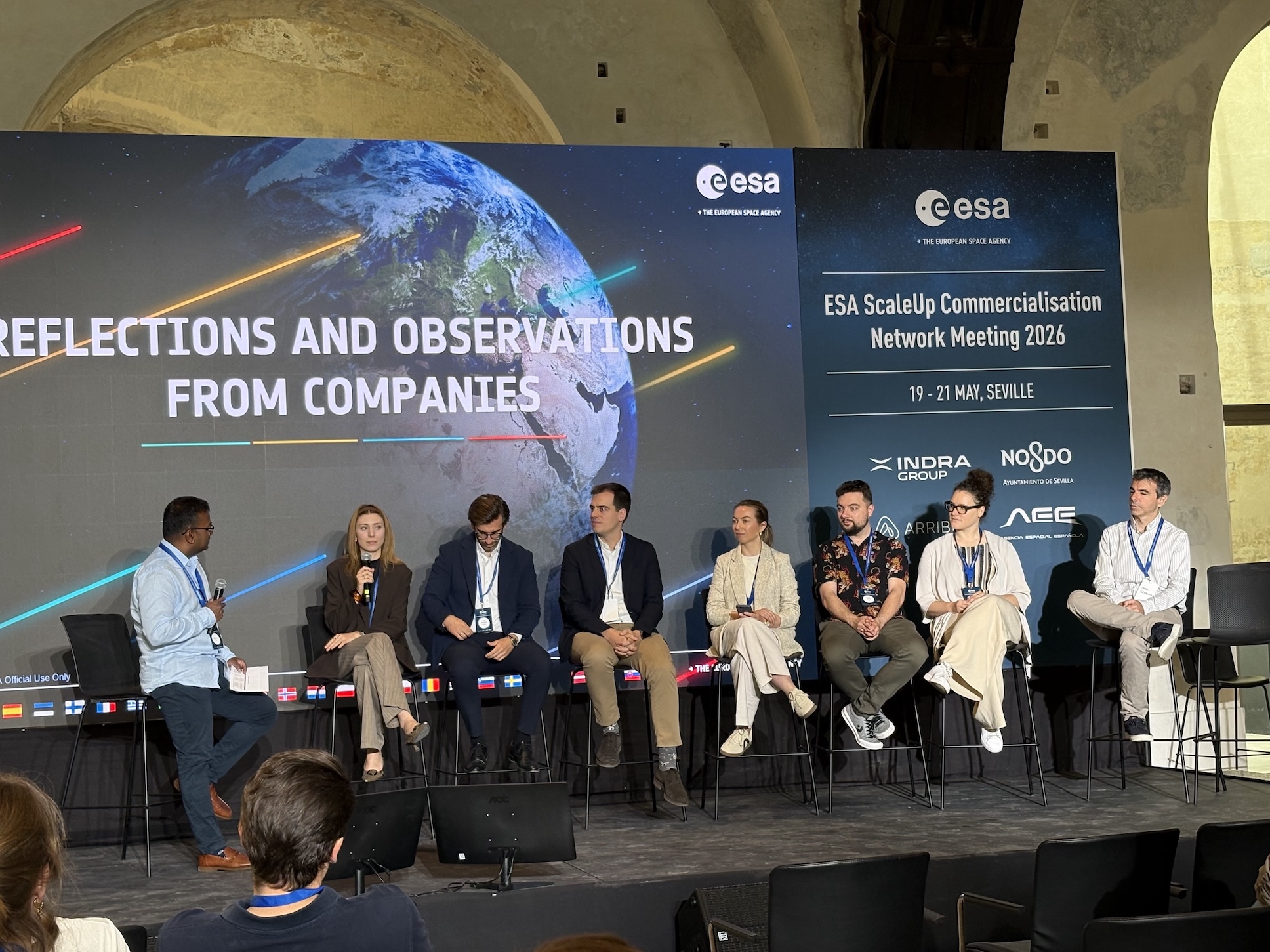
In May, ESA BIC Estonia joined the ESA SCALEUP Commercialisation event in Seville, and brought along one of our own. Marja-Liisa from Antscape, whose urban green infrastructure planning platform is already cutting city planners’ analysis time by 80%, represented Estonia in front of the full ESA business incubation network. Three days that brought together incubator managers, startup founders, and partners from across the European Space Agency’s business incubation network. It is one of the few occasions where the people building this ecosystem actually sit in the same room, and the conversations tend to reflect that.
We were there for all three days. So was one of our own, Marja-Liisa from Antscape, representing Estonia on a European stage.
What Antscape does, and why it matters
Antscape is an ecological intelligence platform for urban green infrastructure planning. In plain terms: it helps city planners, landscape architects, and environmental consultants make faster, better-informed decisions about where and what to plant in urban environments using Earth observation data, biodiversity indicators, and climate risk assessments that previously took weeks to compile manually.
The platform cuts location analysis time by 80% and plant selection time by 70%, while improving long-term plant survival rates through better site-condition matching. It is already being tested in pilot projects across Estonia and Sweden, including as part of the Smart City Challenge 2025/26 with FinEst Centre for Smart Cities, and has received a €60,000 ESA BIC Estonia grant supporting its technological development.
At the Seville event, Marja-Liisa joined a session in which startups from different ESA BIC programmes gave direct, unfiltered feedback on the support they had received, what worked, what fell short, and what they would change. It is the kind of honest input that rarely surfaces in formal settings, and it was well received. Hearing it from someone still in the thick of early-stage development gave the discussion a different weight.
What the network is building
Beyond the individual company stories, the event was also about the infrastructure that makes them possible. BIC managers from across Europe spent the opening day working through the practical mechanics of cross-border cooperation, how knowledge travels between programmes, how one incubator’s experience becomes useful to another, and how to make that happen systematically rather than by accident.
ESA’s stop management outlined the network’s forward direction and discussed how each BIC contributes to the larger picture. New accelerator initiatives were also on the table: focused three-month support tracks for companies graduating from ESA BIC programmes, designed to maintain momentum rather than leave teams to navigate the next phase alone.
One proposal that emerged from the workshops drew broad consensus: a structured mentoring arrangement pairing new BIC managers with experienced counterparts across the network. It addresses a real gap, and the appetite to make it happen was evident.
The broader point
Antscape is one example of what the ESA BIC model is designed to produce: a technically serious company, working on a genuine problem, with access to the kind of institutional support and international network that early-stage deep tech companies rarely find in one place. The Seville event was a reminder of why that network matters — not as a backdrop, but as something that actively shapes what these companies can become.
ESA BIC Estonia returns to Tartu with a clearer sense of where the network is heading and a longer list of people working on the same problems from different corners of Europe.
From Tartu to Seville, ESA BIC Estonia continues to connect Estonian founders with the wider European space network.